|
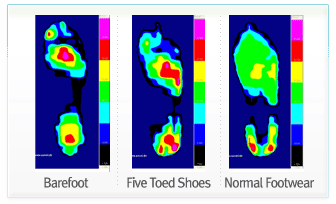
| As a result of analysis of the varying external |
| pressure pattern caused while walking in a |
| quantitative method to identify the degree of |
| comfort when fitting the footwear, we can find |
| that Five Toed Shoes display a pattern of foot |
| pressure very similar to that of barefoot, as |
| shown in Reference Table 2. This means that |
| fitting Five Toed Shoes gives a sense of |
| comfortable wearability like being on barefoot. |
| The foot pressure of normal footwear causes |
| influence on the entire foot, and can be |
| interpreted to have a relatively low wearability. |
|
|
Reference Table 2.
Distribution Chart of Foot Pressure During Walking
" |
|
|
|

|
| When the vertical power, contact surface and |
| pressure value related to the propulsive force of |
| each part of the foot while walking are |
| compared and analyzed among Five Toed |
| Shoes, barefoot, and normal footwear, Five |
| Toed Shoes show that pressure movement and |
| propulsive force in walking are similar to those |
| of barefoot, as displayed in Mask_1~4. |
|
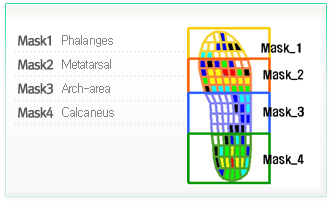 |
Reference Table 3. Mask Field Distribution Chart
|
|
|
|
| |
 Mask 1 Field (Phalanges) Mask 1 Field (Phalanges) |
|
This Field is related to the propulsive force during walking, where the pressure center moves on the big toe |
while walking on barefoot. The maximum pressure value increases in Mask 1 Field in the order of Normal |
Footwear -> Five Toed Shoes -> Barefoot. The Five Toed Shoes is, therefore, very similar to barefoot in its |
| form. |
|
|
|
|
| Mask 1 |
Five Toed Shoes
|
Barefoot |
Normal Footwear |
| Vertical Power (N) |
122.16±72.28 |
117.56±48.11 |
101.58±36.53 |
| Maximum Pressure (N/cm2) |
14.44±3.51 |
16.38±6.62 |
10.44±2.19 |
| Average Pressure (N/cm2) |
4.35±2.34 |
4.19±1.43 |
3.5±1.26 |
| Contact Dimension (cm2) |
19.13±6.30 |
18.32±5.65 |
18.66±2.76
2 |
|
|
|
|
| Mask 2 Field (Metatarsal) |
|
| Mask 2 Field plays a greater role in propulsive force than a big toe. This Field also shows results |
| similar to thoes of Mask 1. |
|
|
|
|
| Mask 2 |
Five Toed Shoes
| Barefoot
| Normal Footwear
|
| Vertical Power (N)
|
539.24±23.58
|
527.54±22.71 |
540.48±84.74 |
| Maximum Pressure (N/cm2)
|
28.63±4.01
|
27.94±3.83 |
18.31±1.55 |
| Average Pressure (N/cm2) |
11.15±0.32
|
10.91±0.43 |
11.01±1.73 |
| Contact Dimension (cm2)
|
46.89±0.86
|
44.26±1.68 |
48.63±0.89 |
|
|
|
|
| Mask 3 Field (Arch area) |
|
| Mask 3 Field plays the role of connecting the metapodium with propodium using the arch segment. |
| The Five Toed Shoes show results very similar to that of barefoot. |
|
|
|
|
| Mask 3 |
Five Toed Shoes
| Barefoot
| Normal Footwear
|
| Vertical Power (N)
|
133.5±73.3
|
90.45±32.54 |
331.49±35.67 |
| Maximum Pressure (N/cm2)
|
22.44±12.92
|
7.94±2.65 |
17.44±1.68 |
| Average Pressure (N/cm2) |
2.51±1.75
|
1.63±0.85 |
6.78±0.73 |
| Contact Dimension (cm2)
|
18.67±5.76
|
19.59±3.67 |
35.25±4.18 |
|
|
|
|
| Mask 4 Field (Calcaneus) |
|
Mask 4 Field is related to shock, and displays similar values between Five Toed Shoes and normal footwear |
compared to barefoot, , but barefoot and Five Toed Shoes have similar values in terms of vertical power. |
|
|
|
|
| Mask 4 |
Five Toed Shoes
| Barefoot
| Normal Footwear
|
| Vertical Power (N)
|
447.78±39.23
|
444.35±39.16 |
402.7±79.1 |
| Maximum Pressure (N/cm2)
|
34.13±8.77
|
19.75±11.89 |
30.5±1.21 |
| Average Pressure (N/cm2) |
9.89±0.89
|
9.81±0.88 |
8.92±1.75 |
| Contact Dimension (cm2)
|
37.42±1.72
|
36.07±3.87 |
33.52±3.85 |
|
| |